The Countertop Audit: How to Vet Zhejiang Kitchen Gear Before It Earns a Spot in Your Kitchen
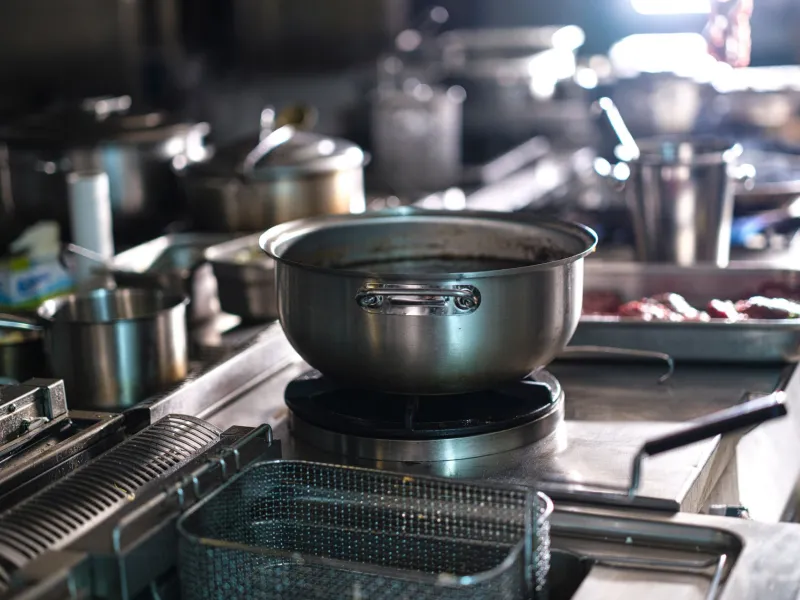
Walk into almost any American kitchen and you'll find something that started its life in Zhejiang. The wok, the rice cooker, the cutting board, the stack of nesting containers nobody remembers buying. The province's manufacturing belt — Yongkang for hard goods and cookware, Cixi for small appliances, Ningbo as the shipping artery — supplies a staggering share of what the rest of the world puts on its counters.
That's the good version of the story. The less good version is that the same supply chain produces an enormous volume of near-miss products: kettles with the wrong voltage, 'stainless' steel that spots after two washes, coatings that flake off in a season. The two are often sold side by side, sometimes with nearly identical photos.
So this isn't a gift guide. It's a standing procedure — the checklist you run before any Zhejiang-sourced kitchen item earns permanent counter space. It'll hold up in June as well as it does in December.
Start with the material spec, not the marketing copy
Marketers write adjectives. Spec sheets write facts. When a listing gives you the latter, that's a signal in itself.
Stainless steel. You want the grade named: 304 or 18/8 for anything that touches food or water, 316 if you're feeling fancy. Grade 201 is cheaper and noticeably more prone to pitting and rust, especially if it goes through a dishwasher. If a listing says only 'premium stainless steel,' assume 201 until proven otherwise. And ignore the old magnet trick — it's folklore, not a test, because both grades can respond to a magnet depending on how they were formed.
Nonstick and ceramic coatings. 'PFAS-free' and 'PTFE-free' are not the same claim. PTFE is a specific chemistry; PFAS is a family. A seller making a real claim will usually offer a third-party test report when asked. If the response is a paragraph of reassurance instead of a document, that tells you something.
Silicone. Ask whether it's platinum-cured food-grade silicone or a general-purpose elastomer with filler. Platinum-cured costs more and behaves better at temperature. A faint rubbery smell that fades after a wash is normal; a smell that sticks around after three is not.
Bamboo and wood. Carbonized bamboo is denser and more water-resistant than the raw stuff. Ask about the adhesive — formaldehyde-free is the phrase you want — and look for FSC certification if sourcing matters to you.
Glass. Borosilicate handles thermal shock; tempered soda-lime is tougher against impact but hates sudden temperature swings. For a kettle or a baking dish, borosilicate is worth the premium.
The four marks that actually mean something in the U.S.
This is where a lot of shoppers get misled, usually by accident.
- UL, ETL, or CSA marks. These come from Nationally Recognized Testing Laboratories, and they're what U.S. regulators, insurers, and inspectors actually look for on anything with a cord. A listing without one is a gamble, full stop.
- FDA food-contact compliance. The baseline claim for utensils, containers, and prep surfaces. It should appear explicitly, not be implied by a photo of a chef.
- LFGB. A German standard, not required in the U.S., but its presence usually correlates with a manufacturer that tests seriously.
- CPSIA. Relevant if the item is aimed at kids — lunch boxes, bento sets, anything marketed to families.
And one mark that means nothing here: CE. It's a European declaration. It says nothing about U.S. electrical safety. Sellers slap it on listings because it looks official, and shoppers assume it's a green light. It isn't.
Voltage, wattage, and the plug trap
The U.S. runs on 120 volts at 60 hertz. Large parts of the world run on 220–240 at 50. A 220V kettle plugged into an American outlet will underperform or simply not boil; worse, the reverse can happen with dual-voltage gear that wasn't designed for continuous 120V use.
Three things to confirm on any powered item:
- 120V / 60Hz stated in the specs.
- A U.S. type-A or type-B plug — not a plug with an adapter thrown in the box. Adapters are not conversions.
- Wattage that fits your kitchen. A 1500W appliance on a circuit shared with a microwave is a recipe for tripped breakers, especially in older apartments.
If a listing is vague on any of these, that's your answer.
Warranty language: separate the real from the wallpaper
'One-year warranty' is one of the most common phrases in online retail and one of the least meaningful on its own. The follow-up questions matter more than the promise:
- Who honors it? A U.S. service address or fulfillment partner means something. A warranty that routes back to a factory in Zhejiang means you'll be shipping a 4-pound appliance across the Pacific at your own cost — often more than the item is worth.
- What's covered? Motors and heating elements are the parts that fail. If the warranty excludes them, it's decoration.
- What voids it? Normal wear, dishwasher use, and 'unauthorized repair' show up as exclusions more often than you'd expect.
- Is there a card? Ask the seller to send the warranty terms before purchase. Sellers with real programs answer in minutes. Sellers without one get vague.
Return-policy red flags
This is the fastest way to sort sellers, and it costs you nothing to check.
- Restocking fees of 15–25% on a $40 item turn a return into a $10 loss before you've paid postage.
- 'Unopened original packaging' clauses mean you can't actually test the thing you bought. That's not a return policy, it's a hope-you-give-up policy.
- A return address in Zhejiang with no domestic option. Postage runs $20–$40 for small appliances, which quietly makes every purchase final.
- Windows measured from the ship date rather than the delivery date. Transit eats the whole window.
- Reviews that mention returns being refused — search the review text for 'return' and 'refund' specifically. People write about this.
Review forensics in five minutes
Product reviews are noisy but not unreadable. A quick pattern scan does most of the work.
Sort by newest first, then read the three-star reviews — that's where people land when something is mostly fine but one detail annoys them, and those details repeat. Search the review text for 'broke,' 'rust,' 'stopped working,' and 'smell.' Look at whether photo reviews show the item in an actual kitchen rather than on a white sweep. And be suspicious of a cluster of five-star reviews posted on the same two days with the same generic phrasing — that pattern is bought, not earned.
What smarter sourcing looks like
None of the above is exotic. It's just rarely offered all at once. The sellers worth bookmarking tend to share a few habits: they publish the spec sheet instead of burying it in bullet points, they state voltage and plug type in the first screen of the listing, they name a U.S. return address, and they prepay duties so the price you see is the price you pay. Some include test reports without being asked.
That's a different shopping experience from the marketplace default, where the cheapest listing wins the click and the buyer absorbs the risk. The tradeoff is a few dollars. The payoff is not spending a Saturday in February mailing a defective kettle back across the ocean.
The six-question checklist
Copy this. Use it every time.
- Is the material grade named — 304 steel, platinum-cured silicone, borosilicate glass?
- For anything powered: is there a UL, ETL, or CSA mark?
- Does it state 120V / 60Hz and a U.S. plug?
- Who honors the warranty, and where do I ship a defective unit?
- Is there a domestic return address, and is there a restocking fee?
- Do the three-star reviews mention a failure that would bother me?
Six questions, about four minutes. That's the whole audit — and it's the difference between gear that lasts a decade and gear that lasts until the next trash day.